
Leveraging HIL-based Re-simulation in Qualcomm CI/CD Pipelines for ADAS and Autonomous Driving Platforms
In today’s rapidly advancing world of automated driving (AD), modern automated vehicles are equipped with more than 10 cameras, multiple radar systems, LiDAR, and a variety of other sensors. This diverse sensor array and the evolving system requirements underscore the need for a comprehensive and strategic approach to simulation for ADAS and AD platform providers. The integration of HIL-based re-simulation, coupled with cloud-native software capabilities, offers a robust solution for technology providers aiming to develop an end-to-end development approach.
Qualcomm Technologies, Inc., one of the leaders in automotive automation, has recognized Xylon’s logiRECORDER and XYLON QUATTRO as flexible HIL platforms suitable for the development and validation of the Snapdragon Ride™ Vision System.

Detail from the Qualcomm Technologies Booth at CES 2023 – HIL Setup with the Xylon logiRECORDER
Qualcomm Technologies teams use various Xylon-based HIL stations to verify ADAS software stacks on different Snapdragon Ride™ Platforms. Typical setups use raw data collected in test vehicles from multiple GMSL2 cameras, radars, GPS, IMU, and CAN-based sensors. Open-loop HIL installations effectively recreate a “vehicle on the bench,” and by playing back the sensory data recordings, they simulate ADAS subsystem workloads equivalent to those of a vehicle driving on the road. The same neural networks that run in the vehicle for perception are executed on the bench—for example, road object detection, lane boundaries, blinker states (e.g., brake, left/right turn signal), and landmark detection.
This process is part of Qualcomm Technologies’ regular software validation before the software is deployed onto vehicles. A comprehensive CI/CD model and framework are also used to schedule tasks running different datasets across various HIL stations at specific times of the day and against different software releases. This allows great flexibility without requiring a test vehicle or driver, enabling faster feedback.
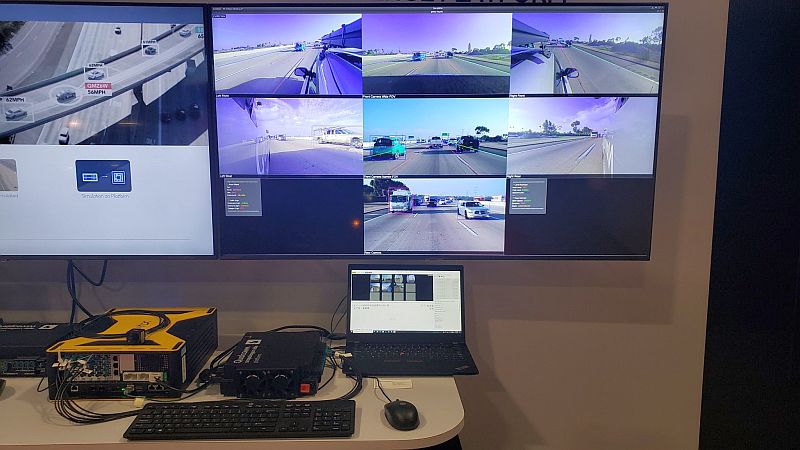
Detail from the Qualcomm Technologies Booth at CES 2023 – HIL setup Handles Multiple Video Camera Streams
Automated HIL Validation

Symbolic Representation of the Automated HIL Test-Bench
The local PC (2) streams the raw sensory data via an Ethernet link to the Xylon logiRECORDER or XYLON QUATTRO (3) device, which injects the pre-recorded or simulated data into Snapdragon Ride platform. The Snapdragon Ride platform receives the injected data and operates as if it were in a real driving car, generating valuable diagnostic data. The PC (2) runs Jenkins automated processes to oversee the entire HIL system, fetch the recorded test data from the company’s cloud (1), and upload the recorded diagnostic data. This setup enables full on-premise or cloud-based analysis of the software stack’s diagnostic data and verification of its compliance with preset KPIs.
Use of Legacy Data Sets

Re-Formatting of Legacy Data
Over the years, Qualcomm Technologies has collected many hours of diverse data sets recorded by test fleets using various third-party equipment, like cameras of different resolutions or Field of Views (FoV). Building up such data collections requires significant effort and associated costs, making it crucial to preserve this valuable legacy data. The Xylon Software Development Kit includes all the necessary tools for data conversion, enabling the reuse of legacy data. In addition to offline pre-processing, the XYLON QUATTRO can convert data in real time, eliminating the need for additional and costly data collection campaigns. In short – old recordings can be converted into Xylon compatible recordings and injected into device under the test.
Tech Challenges: Connectivity, Bandwidth and Storage
To align with Qualcomm Technologies’ high standards, the HIL platform must successfully handle various challenges. To understand how Xylon addresses these challenges, let’s dive into an illustrative example of a sensor suite typical for today’s ADAS/AD architectures. This example sensor suite includes eleven (11) high-resolution cameras for different purposes, multiple LiDAR and radar sensors, as well as several lower-bandwidth sensors that provide important information about the vehicle’s surroundings, and the status of both the driver and the vehicle.

Estimated Data Bandwidths for the Example Sensory Suite
In order to realistically recreate the “vehicle on the bench,” the HIL equipment must be capable of fully replicating such a demanding sensor setup. The main requirements can be broadly divided into three groups: interfacing, data bandwidth, and storage capabilities.
The XYLON QUATTRO is a modular system that can be configured with different I/O modules for native automotive interfaces. The sensor setup presented in the table above can be fully recreated with a single XYLON QUATTRO device. In cases where connectivity requirements significantly increase, multiple XYLON QUATTRO devices can be connected to operate as a single unit.

XYLON QUATTRO with I/O Modules Plugged-in
Though the total data bandwidth of 28 Gbps presents a challenge for the majority of today’s state-of-the-art hardware platforms, the XYLON QUATTRO can easily support data bandwidths two or even three times higher than that.
The example sensor suite generates about 3.5 GB/sec, or roughly 12 TB of data per hour. Since the XYLON QUATTRO offers up to 127 TB of storage space, it can locally store entire days of recordings. This is particularly important in data logging mode or in HIL setups with local data storage. HIL setups with cloud connectivity do not require data copying to the local storage, which further speeds up the overall HIL process.
Snapdragon and Snapdragon Ride are trademarks or registered trademarks of Qualcomm Incorporated.


